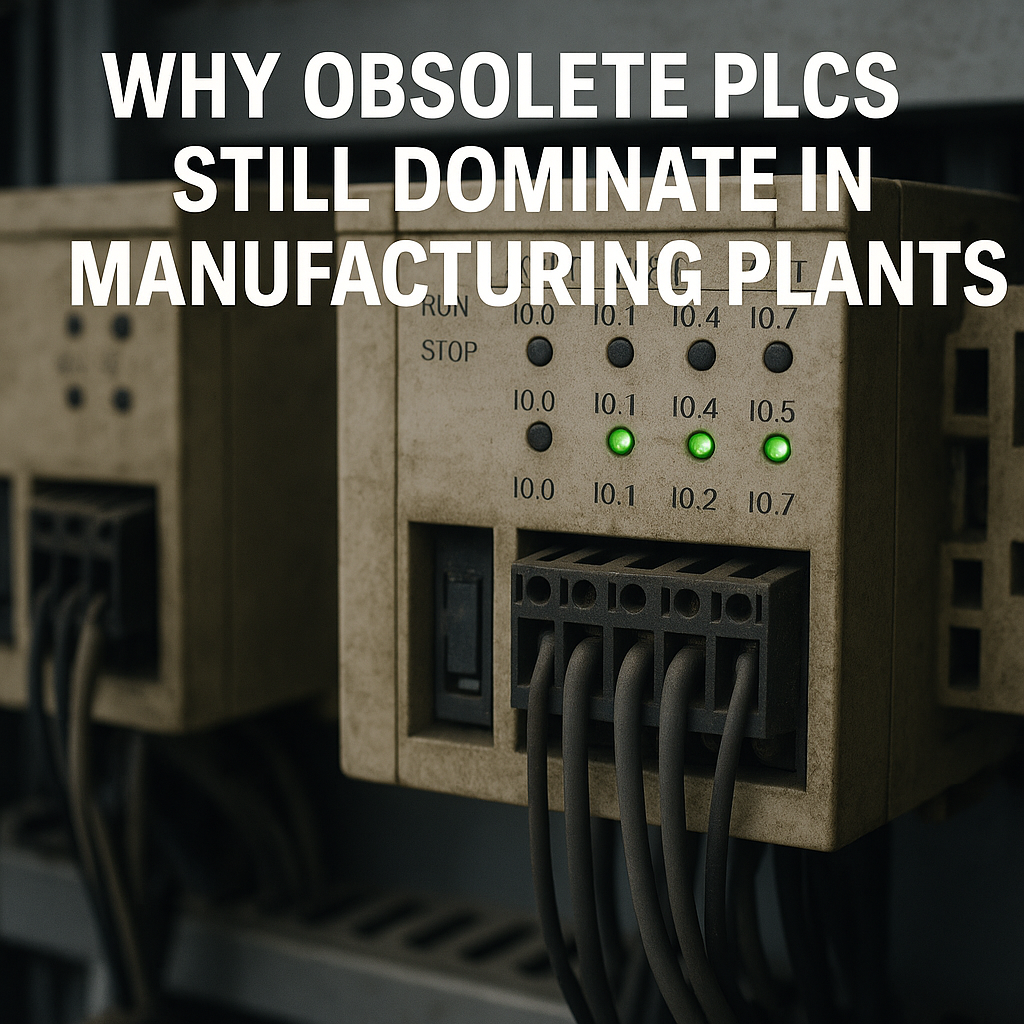
In a world obsessed with digital transformation, it might come as a surprise that many manufacturing plants still rely heavily on obsolete or legacy Programmable Logic Controllers (PLCs). Despite the availability of newer, faster, and smarter systems, these older PLCs continue to dominate factory floors globally. The persistence of these systems isn’t due to resistance to change, but rather a combination of cost-benefit analysis, production risk, and the incredible longevity of these rugged machines.
The first and most obvious reason for the widespread use of obsolete PLCs is cost. Replacing an entire control system is expensive—not just in terms of hardware, but also in downtime, engineering hours, rewiring, programming, and staff retraining. In many industries, especially those with thin margins or highly specialized production lines, the investment required to migrate to a new platform simply doesn’t justify the return. Manufacturers often adhere to the principle of “if it isn’t broken, don’t fix it,” especially when the existing system continues to deliver stable and reliable performance.
Another key factor is system stability. Older PLCs were designed with a core focus on robustness and simplicity. While newer systems may offer advanced features like remote monitoring, AI integration, or cloud-based diagnostics, legacy PLCs excel at one thing: running predefined logic consistently, 24/7, with little maintenance. In fact, some PLCs from the 1980s and 1990s are still operational today, controlling critical processes without a single failure. This level of reliability makes plant managers hesitant to transition to newer systems that may introduce unnecessary complexity or unknown variables.
Downtime is another deal-breaker when considering PLC upgrades. In continuous production environments, every hour of downtime can cost tens of thousands of dollars. Transitioning from an obsolete PLC to a modern one requires careful planning, extensive testing, and in most cases, halting production entirely to make the switch. For some manufacturers, especially those in industries like food processing or pharmaceuticals where downtime can impact compliance or product integrity, the risk simply isn’t worth it. As a result, companies opt to maintain their legacy systems as long as possible.
Support and parts availability are also evolving to meet the needs of legacy systems. A growing niche industry exists specifically to support obsolete PLCs. Third-party suppliers, refurbished component resellers, and automation service providers have made it easier than ever to keep legacy hardware running. Businesses like PLC World specialize in sourcing hard-to-find parts and providing technical support for discontinued systems, helping companies extend the lifespan of their equipment without compromising on performance.
There’s also the issue of custom code and engineering knowledge. Many legacy PLCs run ladder logic or structured text that was custom-written for that particular application—sometimes decades ago. Migrating to a new PLC often means rewriting this logic, a task that can be both expensive and risky if the original developers are no longer available or the documentation is lacking. In this sense, the software becomes as much of a legacy asset as the hardware itself.
Despite the advantages of modern automation platforms, the dominance of obsolete PLCs in manufacturing plants is likely to continue well into the future. For many operations, the choice isn’t about resisting innovation—it’s about making rational, risk-managed decisions based on economics, uptime, and real-world performance. In a high-stakes industrial environment, trust and reliability matter more than flashy features.
That said, the reliance on legacy PLCs shouldn’t discourage forward-thinking strategies. Smart manufacturers are beginning to hybridize their systems—adding modern components like edge gateways, sensors, and SCADA platforms to existing PLC networks. This allows them to bridge the gap between old and new without sacrificing what already works. It’s a reminder that in the world of industrial automation, evolution often looks more like incremental adaptation than a complete technological leap.
In the end, obsolete PLCs persist not because the industry is behind, but because these machines have earned their place. They’ve proven themselves through years of continuous service and remain a critical part of the industrial ecosystem. Until new systems can match that level of affordability, reliability, and trust, it’s safe to say the old guard isn’t going anywhere.